The Algorithm Convinced Me I Wasn’t Beautiful—Then I Paid an Artist $800 to Paint Me
 Photos: Courtesy of Tyler BinghamSave this storySave this story
I don’t consider myself a “beauty girlie.” I’m not subscribed to skin care-focused subReddits or YouTube channels. I never learned how to contour the first time it became popular in the 2010s, let alone new-wave techniques like underpainting. I can’t remember the last time I wore mascara or eyeliner—which, to be honest, are the only makeup I own.
But I'm still a woman in my mid-30s on Instagram, and the algorithm is hellbent on convincing me that I should be doing more. It’s a constant reminder that my everything—skin, hair, ass—could be smoother, longer, tighter, better. One second, I'm pausing mid-scroll, entranced by the seemingly poreless glass skin and visibly toned figure of a stranger in a video about their daily routine; the next, my feed is filled with ads for bio-collagen face masks and glute-growth workout programs.
Someone is always trying to sell us something on our feeds, and our desire to purchase is amplified by insecurity. I’d like to say I’m above the influence of such manipulation, but being served that kind of content daily has still had an impact. Sometimes I catch myself pausing in front of my full-length mirror a little longer than necessary, comparing my nose and thighs against the filtered faces and fitness influencers that inhabit my phone. The only way to avoid it is to avoid being online altogether, which isn’t in the cards for a writer like myself, whose income depends on keeping up with what’s relevant and engaging in self-promotion.
Little did I know that the antidote to my self-conscious doomscrolling would be as simple as sitting still long enough to be truly witnessed.
It wasn’t exactly a confidence boost I was seeking when I booked a live portrait session with Portland-based painter Tyler Bingham. It was the end of a beautiful, brutal summer. I’d come out the other side of a breakup that had emotionally devastated me, so I flung myself around Oregon, checking off all the boxes that had been on my to-visit list since I’d moved to Rose City six years before: Crater Lake, the Alvord Desert, the Wallowas.
I was in a season of wanting to be captured, of wanting to look closely at the woman who’d endured a heartbreak she thought she could not. I wanted permanent images of the in-flux person I was, especially in the midst of the constantly, instantly changeable social media landscape. Somewhere along the way, I had new headshots taken and even did an outdoor boudoir photoshoot in the Columbia River Gorge. Dressed in nothing but lingerie, I glanced back at the photographer’s camera while the sun set against the mountains behind me. It was an homage to the newfound freedom that accompanied my sadness.
Then I learned about the opportunity to be painted from life via Bingham’s Instagram stories (yes, I see the irony). He said to think of it like a tattoo session: up to eight interactive hours during which we’d collaboratively fashion an artistic heirloom in real time. Having sat for more than 20 tattoos, I immediately understood what he meant: Each artwork is like a time capsule, a fleeting moment of life permanently etched onto my body. The portrait session would externalize that process—and at $800 would cost less than some of my biggest tattoos. That it wouldn’t require needles digging into my skin would be a nice change.
"Sometimes, feeling beautiful is just a matter of slowing down, sitting still, and allowing yourself to be seen."
It was a chilly morning in early October when I arrived at Bingham’s studio space, a warehouse walk-up with exposed brick walls and high windows that opened onto the gentle traffic sounds below. The room lacked temperature control, forcing us to stay bundled in our Pacific Northwest layers as we opened with a getting-to-know-you chat and a guided meditation. The session’s focus: gratitude. When I opened my eyes, they landed on the facing wall where Bingham had painted the same word in bright blue, all-capital letters, underlined and punctuated like a sentence. A short distance away: OUR ATTENTION IS MORE VALUABLE THAN OUR TIME in no-nonsense black. I settled into a brightly painted chair across a folding table from Bingham, the canvas that would become my portrait propped up between us. I was about to be the subject of some very intense—and valuable—attention.
Bingham asked me to choose a spot somewhere behind him to fix my eyes. I didn’t have to stay stock-still or gaze there the whole time—our conversation would factor into the portrait and was part of what made the effort collaborative—but for most of the next eight hours, my home base was a single panel of silver-white light in a row of those high windows. Recently, Bingham told me, a client in her 70s had picked that same spot. At the end of their session, she reflected that it was the first time in her life she’d spent a whole day just watching the clouds go by.
It was already becoming obvious that, although Bingham’s work is beautiful, this experience of being painted from life had little to do with how I looked. Our conversation unfurled smoothly through the session. We talked with the intimacy—though not the informedness—of people who’d known each other for years. “How many times have you been in love?” Bingham prompted, his eyes flickering from mine down to the place on the canvas he was sketching them. It felt easy to offer an honest, emotional answer inside the bubble of this safe container, natural to ask the question in return. It wasn’t long before he offered me an opportunity to see the work in progress: a pencil outline over a field of orange, a color I didn’t love and wasn’t wearing. The choice seemed random to me, but as a writer, I appreciate the importance of trusting the process, so I stayed quiet.
As the morning progressed, light moved across and into the space, slowly heating the cold air. Soon, I shed the bulky sweater I’d walked in with, which Bingham had already drawn into the portrait. Now he was in the layering phase, so it was easy to paint it back off again, which he decided to do.
“That’s a really special part of this process, huh?” I commented. “Like, motion and change over time are part of it.”
“I think of it like painting light moving through people,” Bingham responded.
Instagram content
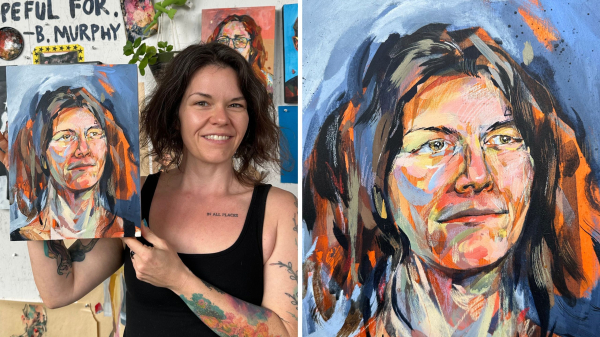
The time passed surprisingly quickly. We took a break around 1 p.m. to eat lunch—the first time either of us had checked our phones all day—and around 4 p.m., our session was done. I was eager to move my body after sitting still for so long, but when he showed me the almost-final product, which he would keep in his studio for a month to make final touches, I gasped. I had never seen myself quite like this before.
The painting’s colors work in a way that makes me understand that I’m not, and will never be, a visual artist: periwinkle across my cheekbone, a slide of minty green marking the curve of my chin, both perfect and unexpected. The brightness cast across both sides of my face does indeed capture the way the light moved through the room. I can see the shadow of the place where my sweater was originally painted, then removed. The fiery orange that had once suffused the entire canvas now only peeks through at my hair and clavicle. Together, the layers create a portrait of a woman I would describe as thoughtful, strong, steady—and plain.
Although Bingham offered no directions either way, I kept my look for the day of the painting low-profile. I maintained my usual makeup-free face and didn’t wear jewelry to the session; I chose clothing—a black tank top over black leggings—that could disappear into the background. When I sent a picture of the painting to a friend, she said it’s well-rendered but doesn’t capture my beauty. And maybe, in some customary, culturally-agreed-upon way, it doesn’t. There are ways to depict my physical features—like emphasizing the arch of my eyebrow or depicting me with a coy smile—that would fall better in line with what it means, in our world, to be beautiful.
"In the face of everything I am, the size of my ass or the smoothness of my skin have become afterthoughts rather than priorities or nagging insecurities."
But when I look at this image of myself, I see a kind of beauty we often overlook in the modern world, one that’s about character and authenticity and shared vulnerability. The painting captures an intimacy that, despite being built quickly and bluntly, felt deep—a friendship constructed in a single day. It’s as much a portrait of Bingham as it is of me, of the two of us in that particular moment. It captures where I was in space and time that day; what and how he saw.
I hung the portrait in my bedroom because it feels too intimate for a more public-facing part of the house. I stare at her over the foot of my bed: this woman who had come through grief she couldn’t have anticipated, a representation of the strength that will take me through everything else that’s coming. A fire that can’t be captured in an Instagram post.
In the face of everything I am, the size of my ass or the smoothness of my skin have become afterthoughts rather than priorities or nagging insecurities. I’m reminded by this portrait that focusing too much on the way my body looks can become an insult to the more important work of being the best version of the person my body carries. And that sometimes, feeling beautiful is just a matter of slowing down, sitting still, and allowing yourself to be seen.